
Investors' wealth eroded by Rs 3.46 lakh crore on Wednesday as equity markets took a sharp tumble amid weak global trends and foreign fund outflows. The 30-share BSE Sensex fell by 676.53 points or 1.02 per cent to settle at 65,782.78. During the day, it plunged 1,027.63 points or 1.54 per cent to 65,431.68. In line with the weak trend in equities, the market capitalisation of BSE-listed firms eroded by Rs 3,46,947.54 crore to Rs 3,03,33,258.69 crore.

'2022 has not been -- and will not be -- the kind of 2021 bull market, which lifted all boats.'

There is no ignoring the fact that world equity markets at this point are in unsustainable parabolic trajectories. The question is when, not if, a deep and sharp correction arrives. Investors need to be prepared for a quick exit if they are riding the rallies at this late stage, says Sonali Ranade

Tyre stocks have been on a tear over the past six months, with average returns exceeding 45 per cent. Except for Apollo Tyres, which has seen a slight correction in the last month and a half, limiting its gains to 16 per cent, listed peers such as MRF, CEAT Tyres (formerly Cavi Elettrici e Affini Torino), and JK Tyre & Industries have delivered returns exceeding 30 per cent during this period. Production-related constraints and sluggish demand in Europe, where sales are expected to remain flat, coupled with high valuations, have contributed to Apollo Tyres' underperformance. The tyre sector's gains can be attributed to robust growth trends driven by the replacement market, which constitutes more than two-thirds of sales.

The bull run in the Indian equity markets is intact, said analysts at Morgan Stanley in a recent note. They expect the S&P BSE Sensex to hit 80,000 levels by December 2023 in their bull-case scenario, to which they have assigned a 30 per cent probability. From the current level, this translates into an upside of nearly 29 per cent.

Stock market investors became poorer by Rs 8.30 lakh crore as equities continued their slide for the sixth consecutive day on Friday. The BSE Sensex has tumbled 1,855.58 points or 3 per cent since February 16. During this period, the combined market capitalisation of BSE-listed firms has tanked Rs 8,30,322.61 crore to reach Rs 2,60,00,662.99 crore. "The domestic market is broadly demonstrating a lack of confidence, registering its sixth consecutive day of losses despite global markets turning green.

The rupee on Tuesday recovered from its all-time intra day low of 77.79 to close higher by 7 paise on a stellar rally in domestic stock markets. After opening lower at 77.67, the local unit plunged further to its all-time intra-day low of 77.79 due to a spike in crude oil prices and disappointing macroeconomic data. However, a strong rally in domestic equities helped the rupee rebound and close at 77.48 (provisional), showing net gains of 7 paise over the last close of 77.55. The forex market was closed on Monday on account of Buddha Purnima.

Kotak Mahindra Bank was the biggest loser from the Sensex pack, skidding 1.83 per cent, followed by Axis Bank, NTPC, Hindustan Unilever, ICICI Bank, Bharti Airtel, Reliance Industries, HCL Technologies, IndusInd Bank and Nestle. In contrast, Bajaj Finance, Bajaj Finserv, Tech Mahindra, Tata Consultancy Services, Titan, Infosys, HDFC Bank, HDFC and ITC were the gainers.

'They can transition from short to long-duration funds when the yield curve normalises.'

Margins for the oil refining and retailing sector have moved off their peaks, and the average integrated margins (refining plus marketing) for oil marketing companies (OMCs) have normalised. The ascent in crude oil prices, combined with static retail prices, has depressed marketing margins for diesel and petrol. However, the fall in marketing margins has been offset by increased gross refining margins (GRMs).

Benchmark indices advanced for the second straight session on Tuesday, with the Sensex and Nifty jumping nearly 2 per cent each, mirroring a rally in global equity markets. Buying in index majors Reliance Industries and IT stocks buoyed the benchmarks. The BSE Sensex zoomed 934.23 points or 1.81 per cent to settle at 52,532.07. During the day, it rallied 1,201.56 points or 2.32 per cent to 52,799.40. The NSE Nifty climbed 288.65 points or 1.88 per cent to finish at 15,638.80.
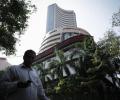
Reliance Industries, Infosys and Tata Motors were the top contributors

The Congress president also came down heavily on the BJP over the Adani issue.

'It will be best for investors to have a systematic investment plan in mid-cap and small-cap funds with a three-/five-year horizon.'
'...over the long-term can be done only by investing in equities.' 'And during weak macros, one needs t1o allocate more than drawing it down, because they offer the best entry point.'

Eicher Motors is a leader in the premium motorcycle segment, where it holds market share of over 85 per cent under the Royal Enfield (RE) brand. The company's joint venture VE Commercial Vehicles (VECV) with Volvo, where it holds 54.5 per cent stake, gives it a strong footing in commercial vehicles (CVs). The company had good results in FY23 and it has a strong balance sheet and good operating margins.

A farmer union leader alleged that the National Investigation Agency is filing cases against those who are part of the protest or supporting it.

The benchmark Sensex is 2.4 per cent shy of a new lifetime high but the market capitalisation (m-cap) of all companies listed on the BSE is already in the record books. At Thursday's (August 18) closing price, the total m-cap of 4,776 firms on the BSE stood at Rs 280.5 trillion, surpassing the previous high of Rs 280 trillion on January 17. This, even if the Nifty Midcap 100 is currently 5.4 per cent below its lifetime high, while the Nifty Smallcap 100 index is down over 20 per cent.
Among the Sensex firms, Kotak Mahindra Bank, Tata Steel, ITC, ICICI Bank, Bajaj Finserv, Maruti, Mahindra & Mahindra and State Bank of India were the biggest winners. Tata Consultancy Services, Infosys, HCL Technologies, Tech Mahindra, Asian Paints, Wipro and Tata Motors were the biggest laggards.

From the Sensex pack, State Bank of India, Axis Bank, IndusInd Bank, Tech Mahindra, HCL Technologies, Tata Consultancy Services, Maruti Suzuki, Tata Steel and Tata Motors were the major gainers. Power Grid and HDFC Bank were the laggards from the pack.

Benchmark equity indices Sensex and Nifty rose by nearly 1 per cent on Friday, extending gains for a second day on the back of buying in banking, financials and energy stocks in line with firm global trends. The 30-share BSE Sensex advanced further by 462.26 points or 0.88 per cent to settle at 52,727.98. During the day, it rallied 644.15 points or 1.23 per cent to 52,909.87. The Nifty gained 142.60 points or 0.92 per cent to settle at 15,699.25.
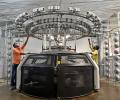
Manufacturing companies have been outperformers on the bourses in the current year, leading to a rise in their weighting in the benchmark index. Companies in sectors such as FMCG, automobile, pharmaceuticals, metals, cement, and agrochemicals now account for 25.43 per cent of the Nifty 50 index, up 88 basis points from 24.55 per cent at the end of December last year and a record low of 23.1 per cent at the end of CY20. The manufacturing sector is now dominated by FMCG majors such as Hindustan Unilever, ITC, Asian Paints, Nestle, and Britannia, accounting for 45 per cent of the combined market cap of all manufacturing companies in the index.
'In the medium to long term mid-caps tend to generate higher returns, albeit with increased volatility.'

The India Meteorological Department on Tuesday said the monsoon this year is expected to be 'above normal.'

We have not suffered such huge price shocks across so many basic commodities, at the same time, in decades. Has the inflationary impact of all this been factored into stock prices as yet, asks Debashis Basu.

'India seems to be on a relatively better wicket compared to other emerging markets.'

The mid-and small-cap segments at the bourses have outperformed their larger peers thus far in fiscal 2023-24 (FY24). While the S&P BSE Small-cap index has surged around 5.7 per cent in FY24, the S&P BSE Midcap index has gained 4 per cent during this period. In comparison, the S&P BSE Sensex has moved up around 2.2 per cent.

In an application filed through the Delhi Police, the Centre has said that it has come to the knowledge of the security agencies that a small group of protesting individuals or organisations have planned to carry out a tractor march on Republic Day.
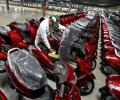
What has hit sentiment further is a draft proposal by the government to increase vehicle insurance premiums for financial year 2022-23 (FY23). Third-party motor insurance premiums have not been increased over the last two years and if this is approved, insurance costs for specific segments could rise by a fifth. The worst impacted is the 350cc and above two-wheeler segment, where premiums are up 21 per cent. Royal Enfield (Eicher Motor) is the market leader in the segment. The premiums in the 150-350cc two-wheeler category are also being inc
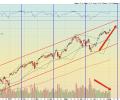
Hoard cash. There will be plenty of time and opportunity at far lower levels, warns Sonali Ranade in her weekly Market Notes

Equity indices staged a pullback on Tuesday after three days of declines as investors scooped up IT, metal and consumption stocks amid a largely positive trend overseas. A recovery in the rupee added to the momentum, traders said. Overcoming a wobbly start, the 30-share BSE Sensex climbed 274.12 points or 0.45 per cent to settle at 61,418.96.

A sharp rally in domestic stocks from June lows has once again rendered Indian markets expensive to their emerging-market (EM) peers. The 12-month forward price-to-earnings (P/E) multiple for the Nifty50 Index is around 20.6x - 82 per cent higher than 11.3 per cent for the MSCI EM Index. India's valuation premium has hit a five-month high. This is on the back of sharp outperformance to EM and global peers from June lows and also due to earnings downgrades, following the April-June quarter of 2022-23 earnings.

Gold prices have surged nearly 18 per cent, so far, in the calendar year 2022 (CY22) to around $2,050 per ounce against the backdrop of the ongoing Russia-Ukraine war and there is more headroom over the next few months, believe analysts at Goldman Sachs who expect the yellow metal to become costlier by another 25 per cent to $2,500 an ounce by the year-end. Goldman Sachs, earlier, had raised its 12-month gold price forecast to $2,150 per ounce considering that an impending US growth slowdown would lead to increased concerns of a US recession and incentivise 300 tonnes of inflows into gold ETFs. At the beginning of the Russia-Ukraine tensions, Goldman Sachs had suggested the resultant rally in commodities could deteriorate the developed market (DM) growth-inflation mix, increase concerns of a American recession, and push gold ETF inflows to 600 tonnes and, in turn, lift gold prices to $2,350 an ounce in 12 months.
Equity markets began the new financial year with smart gains on Friday, with the Sensex rallying over 708 points to recapture the crucial 59,000-mark following gains in index majors HDFC twins and Reliance Industries, along with foreign fund inflows. On the first day of trading in the new financial year, the BSE barometer rallied 708.18 points or 1.21 per cent to settle at 59,276.69. During the day, it jumped 828.11 points or 1.41 per cent to 59,396.62. The broader NSE Nifty advanced 205.70 points or 1.18 per cent to settle at 17,670.45.
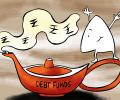
Besides high portfolio yield, investors may enjoy capital gains in debt funds in 2023 as bonds rally in anticipation of rate cuts.

Titan was the top gainer in the Sensex pack, rallying over 5 per cent, followed by Bajaj Auto, Bajaj Finserv, SBI, Nestle India, ITC, Axis Bank and Tata Steel. Nifty rose 46 points to its fresh closing peak of 17,991.95.

Investors have scaled back their allocation to equities as pessimism has reached "dire" levels due to cloudy economic outlook, according to the latest Bank of America (BofA) monthly global fund manager survey that covered nearly 300 money managers with combined assets of $800 billion. The survey showed that the expectations for global growth and profits are at all-time lows and cash levels are at highest since the 9/11 attacks. Interest rate hikes by central banks, the unwinding of an easy monetary regime, disruptions in global supply chains, and fears of recession have heightened market volatility since the beginning of the year.
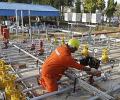
India's top oil and gas producer ONGC on Friday reported a tripling of net profit in the June quarter as it earned record prices before the government slapped a tax on windfall profits arising from a global rally in energy rates. Oil and Natural Gas Corporation's (ONGC) standalone net profit at Rs 15,205.85 crore, or Rs 12.09 per share, in April-June, compared to Rs 4,334.75 crore, or Rs 3.45 a share, in the same period a year back, according to a stock exchange filing by the company. Sequentially, the profit was higher than the Rs 8,859.54 crore net profit of January-March.

'Investors should ideally consider equity allocations from a medium-to-long term perspective.'

Trading volumes for the equities cash segment remained soft, even as the benchmark indices rallied nearly 9 per cent in July. Meanwhile, volumes in the futures and options (F&O) market dipped marginally, but continued to hover at record levels. In July, the average daily turnover (ADTV) for the cash segment was Rs 46,602 crore, up 4.5 per cent month-on-month (MoM), but 26 per cent lower than the preceding 12-month average.
 © 2026 Rediff.com - Advertise with us - Disclaimer - Privacy Policy - Sitemap - Feedback - About us - Terms of use - Grievances